 |
| Borrowed from an excellent blog post about Geita here: https://abenaitwecliff.wordpress.com/category/tanzania-mining-industry/ |
Four of us foreigners (three mzungus and one "cheena") were walking down the street after lunch when two official-looking men pulled up on pikipikis (motorcycles) and asked to see our passports. A few of us are naturally suspicious of being scammed, so we asked them to meet us at our hotel to see our passports, and indeed they followed us back to the hotel. After more kerfuffle all of us, including our local partner and our project officer went to the Immigration Office where I was pretty sure we were going to be shaken down for money.
 |
| A bicycle taxi in Geita, see the extra padded seat on the back? Again, borrowed from an excellent blog post here: https://abenaitwecliff.wordpress.com/category/tanzania-mining-industry/ |
At the time this felt very racist and frustrating, considering all the hassles, price gouging and heckling I receive any time I step foot outside of my apartment here. And yes, I'm well aware of how I'm finally experiencing what life as an outsider/minority feels like and that it's still nothing compared to living in poverty.
 |
| Borrowed from https://abenaitwecliff.wordpress.com/category/tanzania-mining-industry/ |
 |
| From http://wwnorton.com/NRL/english/nawol/maps/MAP30IAF.JPG |
"Nyerere became one of the architects for the formation of the Organisation of African Unity (OAU) and remained an ardent supporter of the continent’s liberation struggles. Tanzania provided facilities for liberation movements such as the African National Congress (ANC), Pan Africanist Congress (PAC), the Zimbabwe African People’s Union (ZAPU), the Zimbabwe African National Union (ZANU), the South West African People’s Organisation (SWAPO), FRELIMO and the Popular Movement for the Liberation of Angola (MPLA), and allowed them to operate from its soil. In addition, the Tanzanian government allowed the organisations to use Radio Tanzania to broadcast messages to their respective countries." (http://www.sahistory.org.za/topic/umkhonto-wesizwe-mk-exile)
The ANC was the anti-apartheid political party of South Africa and Umkhonto we Sizwe or MK, translated "The Spear of the Nation", was the military wing of the ANC. According to my teacher, Tanzanians developed a series of questions to help identify foreigners who could potentially be spies trying to track down the MK. Every village leader was asked to question foreigners or strangers to their villages using these questions and report them to higher government authorities for further questioning. Everyone in the villages were asked to be very aware of people they didn't know and would report them to village leaders.
 |
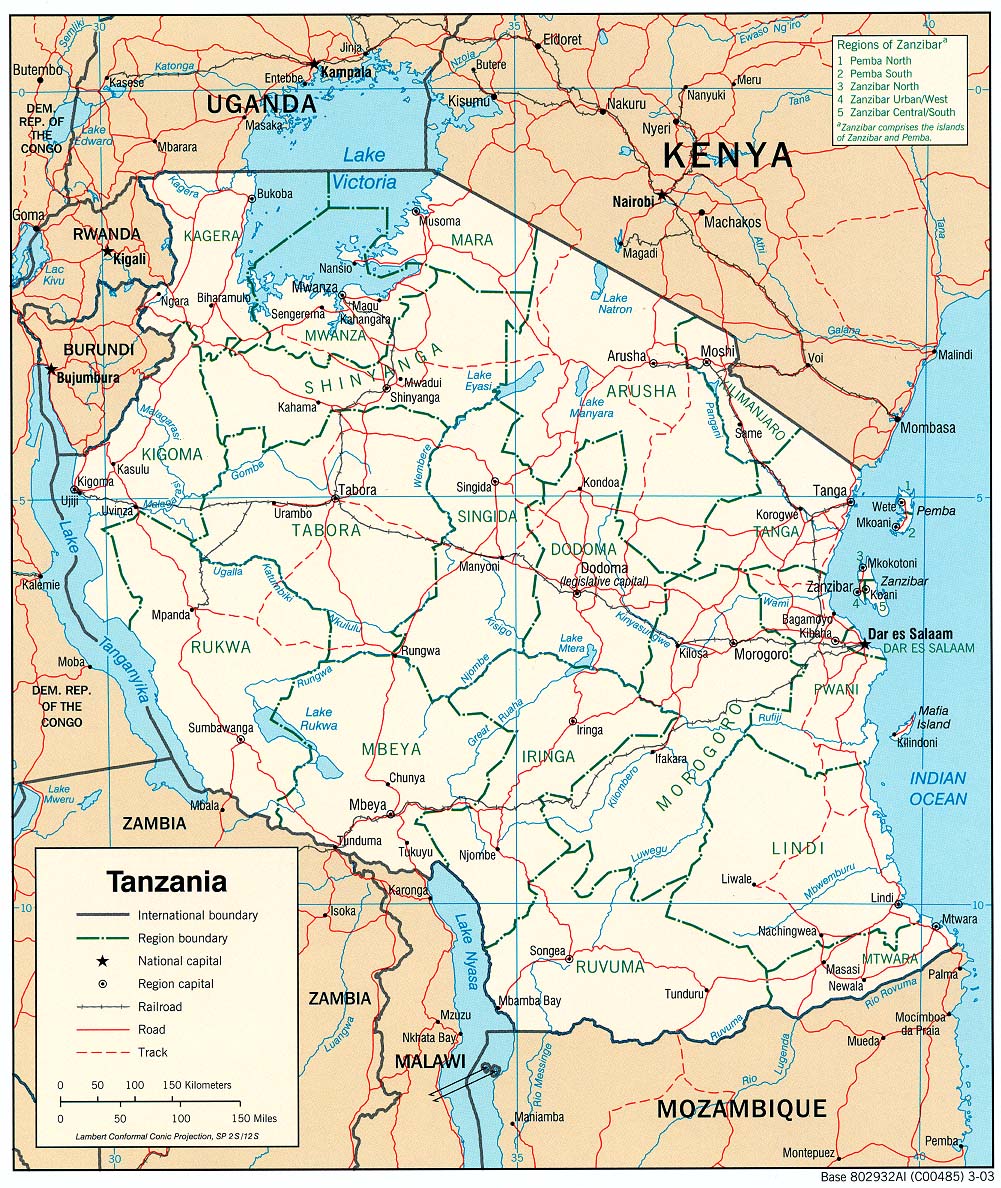
| http://www.lib.utexas.edu/maps/africa/tanzania_pol_2003.jpg |
Even after African countries became self-governed, Tanzania kept this tradition of reporting strangers to their leaders. Tanzania has a very large border shared with many countries (see above), and so refugees often cross into Tanzania. Currently, Burundi refugees have been fleeing to Tanzania, as discussed on CBC by my friend Sophie Trembley: http://www.cbc.ca/beta/news/burundi-refugees-fleeing-to-tanzania-1.3078934. During the dark years of Idi Amin's reign in Uganda spies were prowling around Tanzania looking to hunt down Amin's opponents, and apparently villagers reporting strangers was key to keeping massive violence from breaking out.
This system of questioning and reporting strangers has been in place for decades. My teacher attributes the continued peace and low level of terrorism in Tanzania partially to this practice. We told our teacher about our encounter with the immigration officers in Geita and she let us know that Geita is actually a hot spot for illegal workers as well as human trafficking due to the proximity of the mine.
With all this new information I feel a lot better about my experience with immigration in Geita. The importance of context.
 |
| On the road to Geita. |
Unaitwa nani? (What are you called?)
Unatoka wapi? (Where are you from?)
Unakaa wapi? (Where are you staying?)
Umekuja lini? (When did you arrive?)
Utakaa muda gani? (How long will you stay?)
Umekuja kufanya nini? (What have you come to do?)


So the part where you said Tanzania was one of the first African countries to gain independence lead me to this blog posting about African independence, because when I went to Ghana, people there believe they were the first and so had created the movement of independence in Africa http://www.africaontheblog.com/ghanas-dubious-decolonization-distinction-the-first-independent-african-country/ I know it's not specific about Tanzania but it is funny how each country in Africa kind of have their own ideas about starting the independence movement in the continent
ReplyDeleteHa! I could see how each country would vie for the title of first past the (independence) post! Well, perhaps Tanzania was just "one of the first" as in, they were among the first wave of liberated countries. Thanks for the article and thought provoking :)
ReplyDeleteActually, maybe Tanzania was just among the early one in East Africa.
ReplyDelete